- +92-302-8577025
- qkzeetech@gmail.com
- shop 20, 1st floor Al-khalil Center Hall Road , Lahore
Choosing the right final year project is more than just a requirement — it can define your career path, skill set and future opportunities. The right project shows your technical skills, creativity and ability to solve real-world problems.
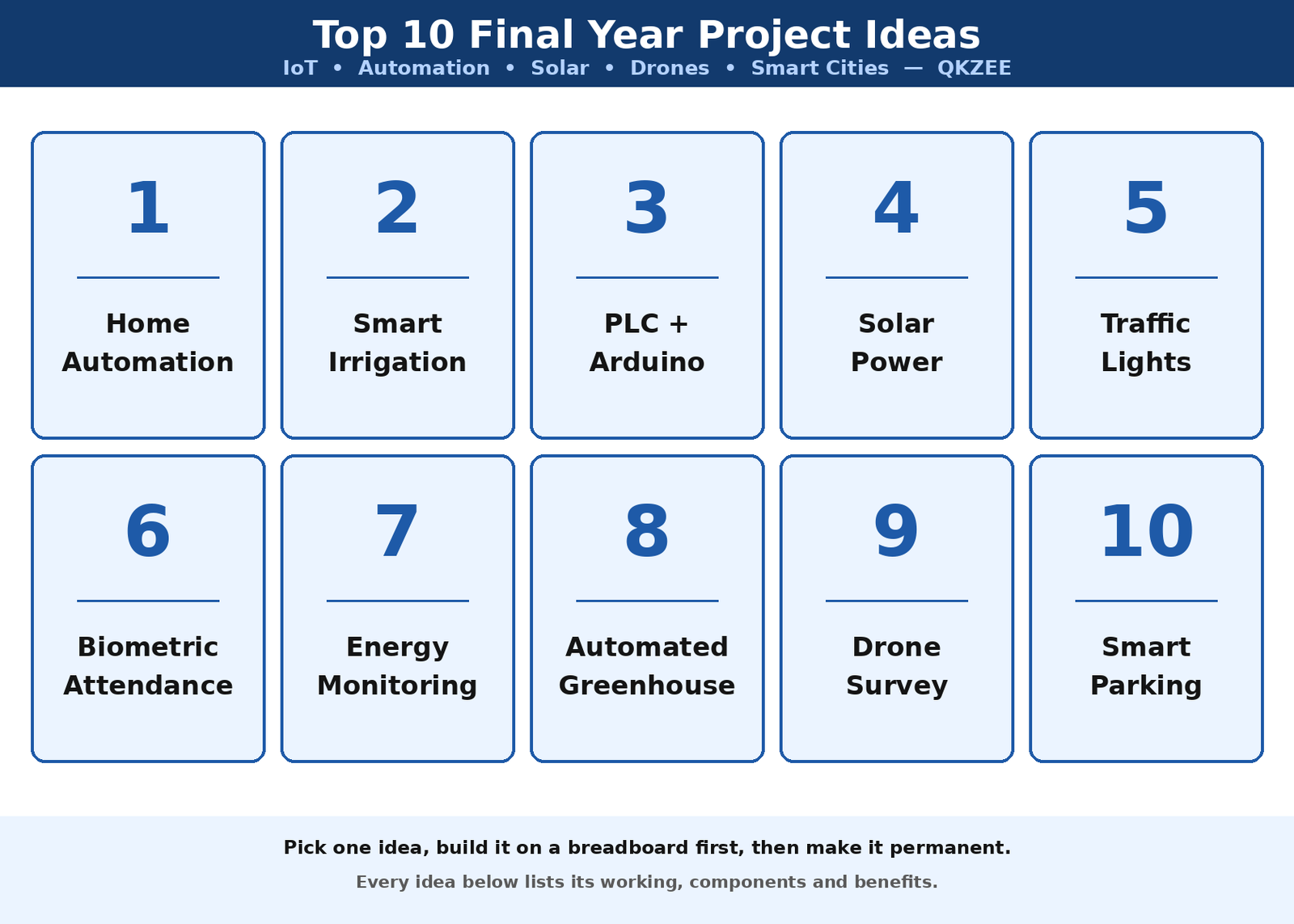
Here is a detailed guide with working principles, components required, usage and benefits — ten ideas for engineering students, semester projects, final year projects, agriculture projects, IoT projects and industrial automation.
This project lets you control home appliances like lights, fans or AC units using your smartphone. With the ESP8266 Wi-Fi module connected to the Blynk app, you can turn appliances ON/OFF from anywhere.
See our guide: How to Connect a Relay Module with Arduino — the relay is the part that switches the appliances.
The soil moisture sensor checks the dryness of soil. If moisture is low, the ESP8266 activates a pump via a relay, automatically watering the plants. Data is shown on the Blynk app.
See our guide: ESP8266 IoT Soil Test Station — it reads the same soil sensor and uploads the data to ThingSpeak.
Combining PLC (Programmable Logic Controller) with Arduino creates a low-cost, flexible automation system. PLC controls industrial processes, while Arduino/ESP8266 handles IoT monitoring and small tasks.
See our guide: Industrial Automation – PLC & Arduino Integration Guide — it explains how the two work together.
The solar panel generates electricity stored in a battery using a charge controller. An inverter converts DC into AC, making it usable at home. Arduino/ESP8266 can monitor performance.
See our guide: DIY Solar Power System – Step-by-Step Guide for Students — it walks through the wiring setup.
Uses IR sensors to detect vehicles. Based on traffic density, signals adjust automatically, reducing congestion. Controlled by ESP8266 or Arduino Mega.
See our guide: Smart Traffic Control System Using Image Processing — it builds a 4-lane traffic system with Arduino and OpenCV.
Attendance is marked through fingerprint scanning. Data is stored and displayed using ESP8266 and can be accessed via IoT apps.
See our guide: ESP8266 Smart Classroom Attendance System — it builds the same system with an RFID reader instead of a fingerprint sensor.
This project measures current and voltage using sensors connected to ESP8266. Data is sent to the Blynk app for real-time monitoring.
See our guide: Wireless Energy Meter with Mobile Billing — it measures energy with a PZEM-004T and an ESP32 and uploads it to ThingSpeak.
Sensors measure temperature, humidity and soil moisture. ESP8266 controls pumps, fans and lights automatically to create the best plant-growing conditions.
See our guide: Automatic Tap Water System with IR Sensor and Relay — it shows the same pump-and-relay control in a working build.
A drone equipped with GPS and a camera surveys farmland. It helps farmers analyze crops, soil conditions and irrigation needs.
This is the most advanced idea on the list — it needs a bigger budget and more time than the others. If your university has a drone lab, ask your supervisor before choosing it.
Uses ultrasonic sensors to detect empty slots. Data is displayed on an app or screen, guiding drivers to available parking spaces.
See our guide: IoT Smart Parking System with Arduino & ESP32 — it builds the full system with IR sensors, a servo gate and ThingSpeak.
Whichever you choose, build it on a breadboard first, test it, then make it permanent. See our How to Use a Breadboard guide if you have never used one.
The parts listed above are available at QKZEE Technologies, Shop 20, 1st Floor, Al-Khalil Center, Hall Road, Lahore, and online at qkzeetech.com with delivery all over Pakistan — see the links in each idea. Parts marked "not a QKZEE listing" are available at the Hall Road shop on request.
If you cannot decide which project to pick, or you have picked one and do not know where to start, message us — tell us your degree, your budget and your deadline, and we will help you choose.
Message us on WhatsApp Watch on YouTube
Which final year project is the easiest?
Home Automation or Smart Parking. Both use one NodeMCU, a few sensors and short code, and every part is available at the shop.
Which project is best for an agriculture student?
Smart Irrigation or Automated Greenhouse. Both use the soil moisture sensor and a pump, and they are easy to demonstrate to examiners.
How much does a final year project cost?
A basic Arduino/NodeMCU project costs Rs 1,000–3,000 in parts. A PLC or drone project costs much more — check the parts list of your idea before you commit.
Can I buy a ready-made project?
Yes — QKZEE Technologies builds ready-made systems on order, and the components are also available separately. Message us on WhatsApp with your project idea.
Do these projects work for a semester project too?
Yes. Most of these ideas scale down — build one part of the system (for example, just the irrigation sensor) for a semester project, then extend it for your final year.
What if a part is not listed on the shop?
Message us on WhatsApp — many parts (PLC units, solar panels, fingerprint sensors, drone parts) are available at the Hall Road shop on request even when they have no online listing.
These Top 10 Final Year Project Ideas are designed for engineering students in Pakistan who want to learn skills in IoT, automation, renewable energy and industrial projects. Whether you want an affordable DIY project or an advanced industrial solution, these ideas are your starting point. Pick one, build it on a breadboard, and make it work — that is what examiners remember.