- +92-302-8577025
- qkzeetech@gmail.com
- shop 20, 1st floor Al-khalil Center Hall Road , Lahore
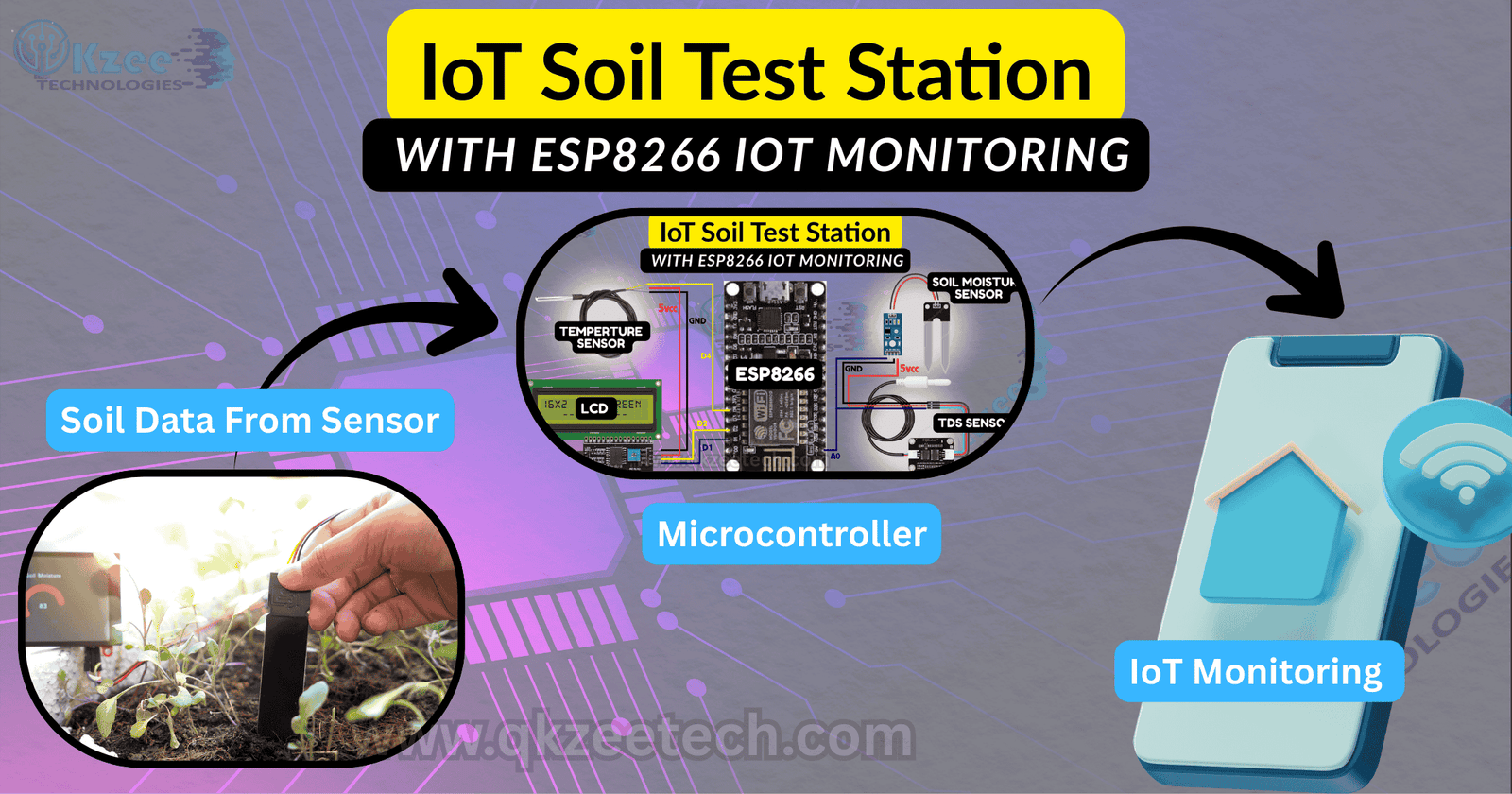
We introduce a complete, field-ready guide on how to build an ESP8266 IoT Soil Test Station, designed especially for students projects, final year projects, and engineering projects in Lahore, Pakistan. This portable device measures soil moisture, soil temperature, and TDS (Total Dissolved Solids), then uploads real-time data to an IoT cloud platform. As a result, farmers, researchers, and institutions gain actionable insights for precision agriculture and sustainable farming.
In Lahore, Pakistan, where agriculture and research institutions increasingly rely on automation and IoT, this project stands out as one of the best engineering projects available near me for electronics engineering, electrical projects, and industrial projects.
The ESP8266 IoT Soil Test Station is a compact, low-power, and portable system. It collects soil parameters using high-accuracy sensors, processes the data with the ESP8266 Wi-Fi microcontroller, and uploads readings to platforms such as Firebase, Blynk IoT, or ThingSpeak IoT.
This system is suitable for school projects, science projects, university projects, and advanced final year projects, offering hands-on experience in IoT, sensors, and data analytics.
The device inserts probes directly into the soil. The soil moisture sensor measures water content, the DS18B20 temperature sensor monitors soil temperature, and the TDS sensor estimates nutrient concentration. The ESP8266 reads sensor data, formats it, and transmits it wirelessly to the cloud.
Farmers and researchers can how to use dashboards to monitor trends, receive alerts, and optimize irrigation and fertilization schedules. Consequently, this project demonstrates practical automation and IoT skills expected in best engineering services.
We design the hardware architecture to meet both academic and real-world standards, making it ideal for DLD projects, arduino projects, and esp8266 projects.
| Component | Model / Description |
|---|---|
| Microcontroller | ESP8266 NodeMCU |
| Soil Moisture Sensor | Capacitive Soil Sensor |
| Temperature Sensor | DS18B20 Waterproof |
| TDS Sensor | Analog TDS Module |
| Display (Optional) | 16×2 LCD with I2C |
| Power Source | Rechargeable Battery / Power Bank |
| Software | Arduino IDE |
All electronics parts are easily available at the Hall Road electronics market in Lahore, ensuring the best price for student projects and a controlled price of final year projects.
| Component | ESP8266 Pin | Function |
|---|---|---|
| Soil Moisture Sensor | A0 | Measures soil moisture |
| DS18B20 Data | D4 | Soil temperature (OneWire) |
| TDS Sensor | A0 (via multiplexer) | Nutrient level |
| LCD SDA | D2 | I2C data |
| LCD SCL | D1 | I2C clock |
Proper grounding and voltage regulation are implemented to protect sensors, making the design reliable for industrial automation and research-based engineering projects.
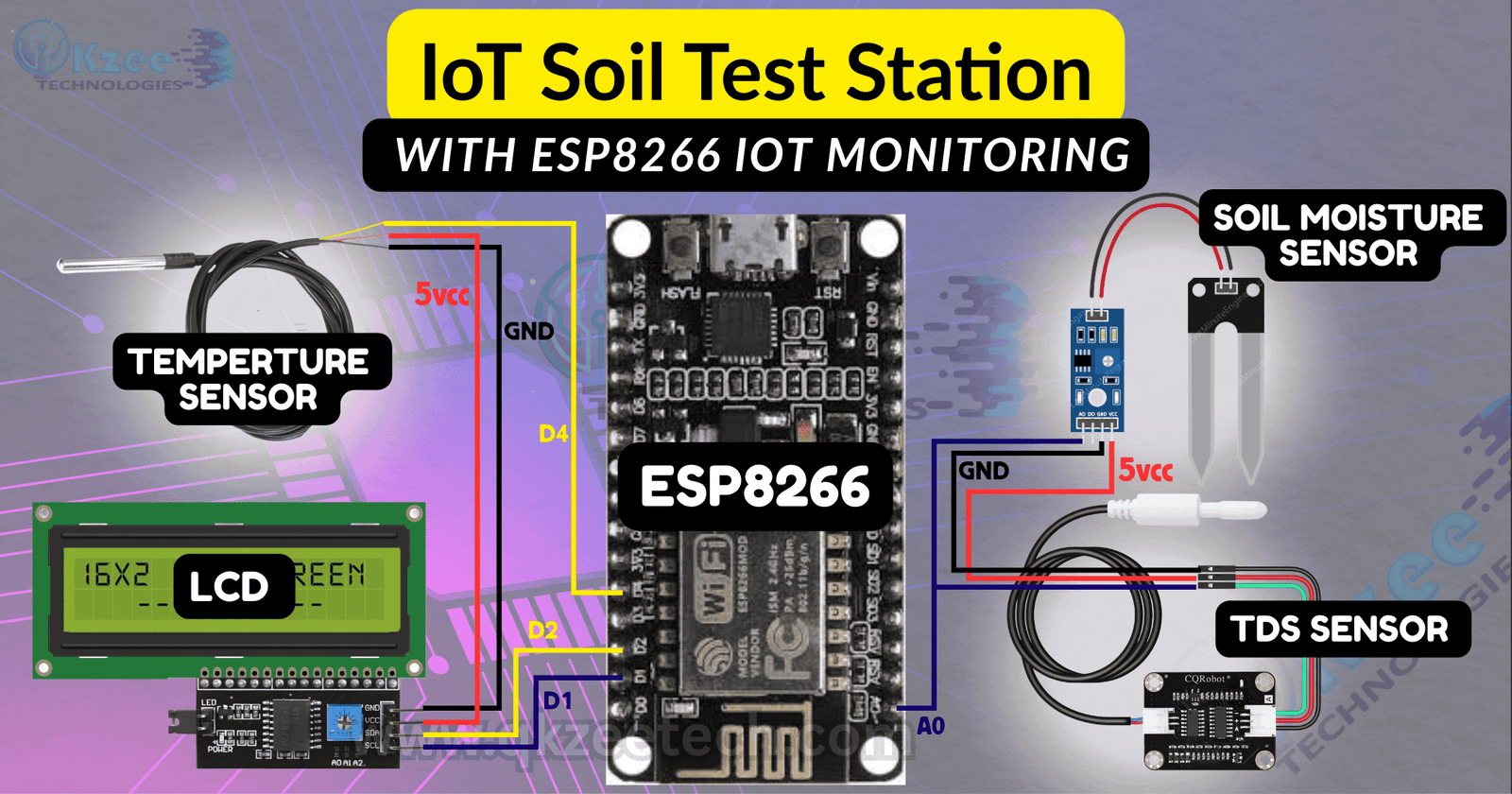
We program the ESP8266 using Arduino IDE. The firmware reads sensor data, applies calibration formulas, and uploads values to the cloud. Transitioning from raw data to meaningful metrics enhances learning for student projects in Lahore.
Supported IoT platforms include:
Firebase projects for real-time databases
Blynk IoT projects for mobile dashboards
ThingSpeak IoT for data analytics
This flexibility makes the project suitable for raspberry pi projects, imaging processing projects, and future AI-based research.
#include <ESP8266WiFi.h>
#include <OneWire.h>
#include <DallasTemperature.h>

#define SOIL_MOISTURE A0
#define ONE_WIRE_BUS D4

OneWire oneWire(ONE_WIRE_BUS);
DallasTemperature sensors(&oneWire);

const char* ssid = "YourWiFi";
const char* password = "YourPassword";

void setup() {
  Serial.begin(9600);
  WiFi.begin(ssid, password);
  sensors.begin();

  while (WiFi.status() != WL_CONNECTED) {
    delay(500);
  }
}

void loop() {
  int moisture = analogRead(SOIL_MOISTURE);
  sensors.requestTemperatures();
  float temperature = sensors.getTempCByIndex(0);

  Serial.print("Soil Moisture: ");
  Serial.print(moisture);
  Serial.print(" | Temp: ");
  Serial.println(temperature);

  delay(2000);
}
This code fulfills academic requirements for electronics projects, arduino robots, and DIY projects, while remaining easy to expand.
This system is ideal for:
Smart farming
Agricultural research
Biomedical and medical science model projects
Industrial projects
Robotics and automation
University and final year projects
Its portability and data-driven design make it one of the best engineering projects in Pakistan.
We collaborate with QKZ, QKZ Tech, and QKZee Technologies to provide best engineering services, project kits, and expert consultation.
Homepage: QKZee Technologies
Engineering Services: View Services
Buy Components / Kits: Shop Now
Engineering & Student Projects: Explore Projects
Consult with Qasim Shahzad: Get in Touch
Students searching for the best shop for student projects in Lahore Pakistan consistently trust this platform.
Future upgrades include GPS tagging, AI-based soil analysis, mobile alerts, solar power integration, and multi-node farm monitoring. These features elevate the project from student projects to scalable industrial automation systems.
Looking for affordable components for this Arduino project? Check out QKZee Technologies, an online shop in Lahore, Pakistan, offering the best components for students and DIY projects. Whether you’re looking for sensors, modules, or other electronics at a cheap price, they’ve got it all. Visit them at QKZeeTech.