- +92-302-8577025
- qkzeetech@gmail.com
- shop 20, 1st floor Al-khalil Center Hall Road , Lahore
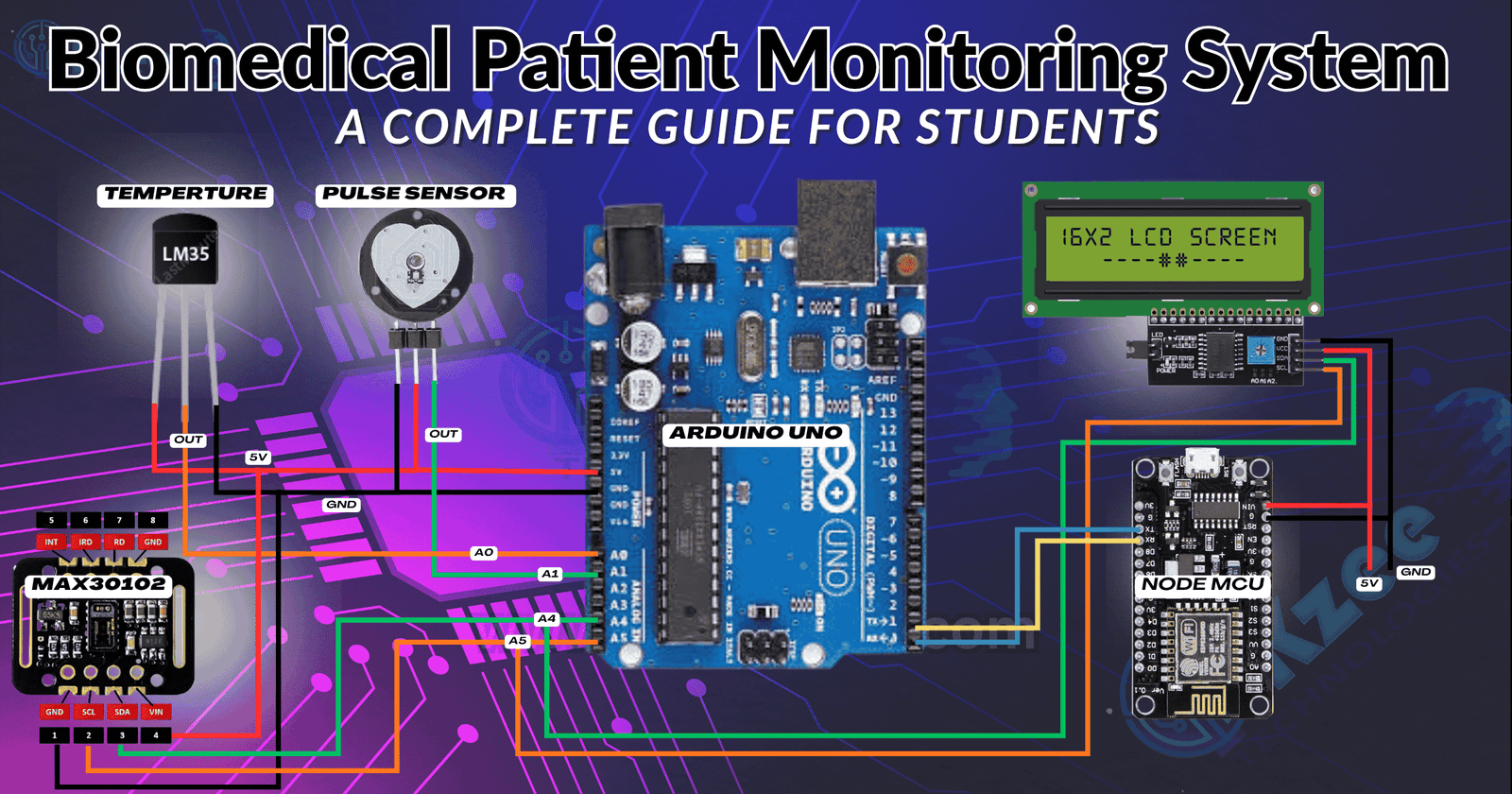
In today’s fast-paced world, healthcare automation plays a crucial role in saving lives. Whether you’re an engineering student searching for final year projects in Lahore or a beginner looking to build something impactful, a Biomedical Patient Monitoring System is an excellent project. It combines IoT, sensors, Arduino, and medical technology to continuously track vital health parameters like heart rate, temperature, and oxygen level.
This guide will explain how to make and how to use a patient monitoring system, with full details about circuit diagrams, components, and software setup. Designed by experts like Qasim Shahzad and his team at QKZee Technologies (QKZ Tech) in Lahore, Pakistan, this project demonstrates innovation at the best price for students projects and engineering enthusiasts.
A Biomedical Patient Monitoring System is an IoT-based medical project that records and transmits a patient’s vital signs. It helps doctors monitor patients remotely in hospitals or at home. The system typically tracks:
Body Temperature
Heart Rate
Oxygen Saturation (SpO₂)
Blood Pressure (optional)
ECG (optional)
These parameters are displayed on an LCD screen or sent to a mobile app via Wi-Fi, allowing healthcare professionals to monitor patients in real time.
Students often struggle to find the best engineering projects in Lahore that are practical, affordable, and technically advanced. This biomedical project is ideal because it integrates electronics, IoT, sensors, and automation. It also demonstrates expertise in Arduino programming, real-time data communication, and healthcare innovation.
Moreover, QKZee Technologies, located at Hall Road Electronics Market, Lahore, offers consultation for final year projects in Pakistan, providing all components and technical support near you.
To make the Biomedical Patient Monitoring System, you’ll need the following electronics parts:
| Component Name | Description |
|---|---|
| Arduino UNO / Mega | Microcontroller for system operation |
| Pulse Sensor | Measures heart rate |
| LM35 Temperature Sensor | Measures body temperature |
| MAX30100 or MAX30102 | Monitors SpO₂ and pulse rate |
| 16×2 LCD Display | Displays readings locally |
| ESP8266 (Wi-Fi Module) | Sends data to IoT platforms like ThingSpeak or Firebase |
| Breadboard and Jumper Wires | For circuit connections |
| Power Supply (5V) | To power the circuit |
All of these parts are available at QKZee Technologies, one of the best shops for student projects in Lahore, Pakistan, offering quality components at the best price.
Connect the LM35 sensor output pin to A0 of Arduino.
Connect the Pulse Sensor to A1.
Attach the MAX30102 module using SCL and SDA pins for I²C communication.
Connect the LCD Display using 4-bit mode or via I²C adapter.
Pins VCC and GND to 5V and GND respectively.
Connect SDA → A4, SCL → A5.
Attach the ESP8266 module to Arduino.
TX → RX and RX → TX cross-connection.
Use 5V regulated supply to power ESP8266.
You can use the Arduino IDE for programming.
Wire.h – For I²C communication
Adafruit_MAX30102.h – For pulse and SpO₂
LiquidCrystal_I2C.h – For LCD display
ESP8266WiFi.h – For internet communication
#include <Wire.h>
#include <LiquidCrystal_I2C.h>
#include <Adafruit_MAX30102.h>
LiquidCrystal_I2C lcd(0x27,16,2);
Adafruit_MAX30100 pulseSensor;
void setup() {
lcd.begin();
pulseSensor.begin();
lcd.print(“Biomedical System”);
}
void loop() {
  float temp = analogRead(A0) * 0.488;
  lcd.setCursor(0,1);
  lcd.print("Temp: ");
  lcd.print(temp);
  delay(1000);
}
This program continuously reads temperature data and displays it. You can expand it by adding heart rate, SpO₂, and Wi-Fi data upload functions.
You can send data to cloud platforms like:
ThingSpeak IoT
Firebase
Blynk IoT
Using ESP8266 or NodeMCU, you can monitor patient data on a smartphone dashboard in real time. This allows remote patient care — an essential feature for modern medical science model projects and IoT-based systems.
The LM35 measures body temperature, while pulse sensors detect heartbeat by sensing changes in blood flow.
MAX30102/max30100 combines both heart rate and SpO₂ readings. The Arduino processes these analog signals, converts them to digital values, and displays them on the LCD.
Through ESP8266, this data is uploaded to the IoT cloud for real-time monitoring.
Hospitals for continuous patient monitoring
Home healthcare systems for elderly or chronic patients
Wearable devices for fitness tracking
University and school projects to learn biomedical IoT applications
Low-cost and easy to assemble
Real-time monitoring through IoT
Accurate and reliable sensor data
Expandable for additional parameters (ECG, blood pressure, etc.)
| Challenge | Solution |
|---|---|
| Signal noise from sensors | Use proper filtering and shielded cables |
| Wi-Fi disconnection | Add reconnection logic in code |
| Sensor calibration | Compare readings with clinical devices |
The price of final year projects like this varies based on features and sensors used.
| Component | Estimated Cost (PKR) |
|---|---|
| Arduino UNO | 1,800 |
| LM35 Sensor | 300 |
| MAX30102 | 1,200 |
| ESP8266 | 900 |
| LCD Display | 700 |
| Others wiring and programing | 2000 |
| Total | ≈ 6,500 – 7,000 PKR |
You can get all these components at QKZee Technologies, Hall Road, Lahore, offering best prices for student projects in Pakistan.
The Biomedical Patient Monitoring System is an innovative and practical IoT-based project suitable for students, electrical engineers, and medical technology enthusiasts. It merges electronics, sensors, and software to create a life-saving device.
Whether you’re looking for university projects in Lahore, IoT automation ideas, or consultation for final year projects, QKZee Tech offers expert support, tutorials, and ready-made kits to bring your ideas to life.
Looking for affordable components for this Arduino project? Check out QKZee Technologies, an online shop in Lahore, Pakistan, offering the best components for students and DIY projects. Whether you’re looking for sensors, modules, or other electronics at a cheap price, they’ve got it all. Visit them at QKZeeTech.