- +92-302-8577025
- qkzeetech@gmail.com
- shop 20, 1st floor Al-khalil Center Hall Road , Lahore
A MOSFET transistor (Metal-Oxide-Semiconductor Field-Effect Transistor) is one of the most important components in modern electronics. Whether you're building student projects, final year engineering projects, or industrial automation systems, the MOSFET is the heart of countless circuits.
At QKZee Technologies in Lahore, engineers and students rely on MOSFETs for power efficiency, high-speed switching, and precision control.
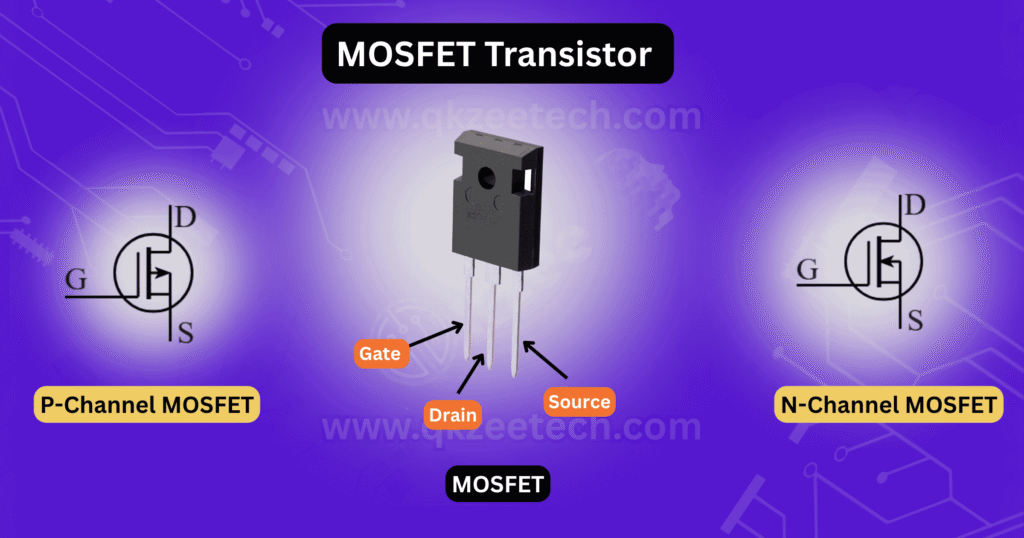
A MOSFET has three terminals — Gate, Source, and Drain.
Between these, a thin oxide layer isolates the gate, allowing voltage control without direct contact.
The MOSFET working principle is simple yet fascinating — voltage controls current flow.
When a voltage is applied to the Gate terminal, it creates an electric field that allows electrons (or holes) to flow between the Source and Drain.
Think of it like a water tap — the Gate is the handle, the current is water, and the Drain is the outlet. Turn the voltage (handle), and the current starts or stops flowing.
MOSFETs are classified in two different ways — by channel and by mode. These are two separate axes, so a single MOSFET is described by both: for example, an "N-channel enhancement-mode" MOSFET. Most Arduino projects use that type.
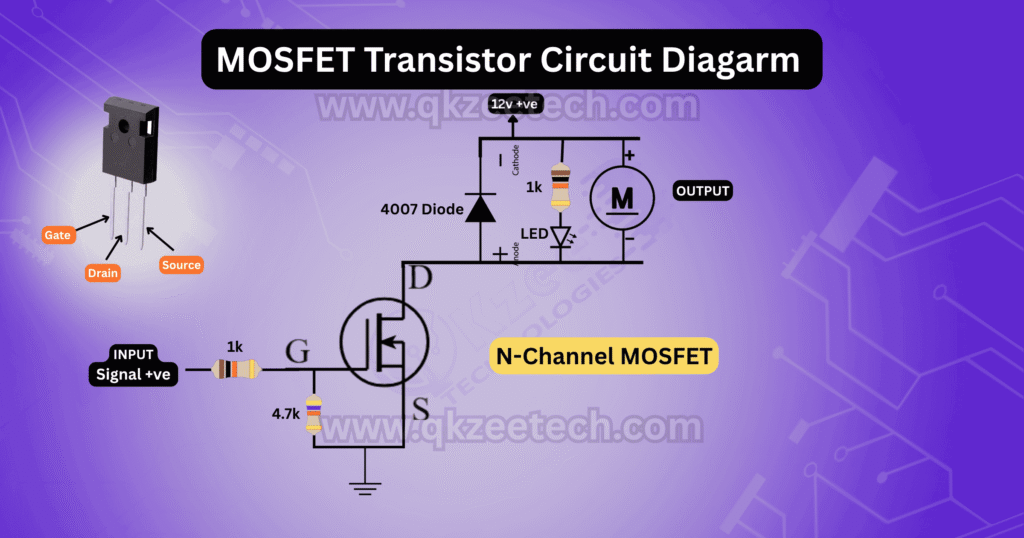
Using a MOSFET is easier than it looks. Here's a simple Arduino example — a DC motor switched through an N-channel MOSFET:
Why the two resistors? The 1kΩ series resistor limits the inrush current into the MOSFET gate and protects the Arduino pin. The 10kΩ pull-down keeps the MOSFET OFF while the Arduino pin is floating — during reset or upload — so the motor doesn't spin on its own. For the full explanation, see our DC motor speed control with 75NF75 MOSFET guide.
Arduino Code:
// DC motor speed control with an N-channel MOSFET
// Gate -> 1kΩ -> D9 (PWM) | 10kΩ pull-down Gate -> GND
// Source -> GND | Drain -> motor (-) | motor (+) -> 12V
const int gatePin = 9;  // PWM pin

void setup() {
  pinMode(gatePin, OUTPUT);
}

void loop() {
  // Ramp the motor speed up, then down
  for (int speed = 0; speed <= 255; speed += 5) {
    analogWrite(gatePin, speed);
    delay(30);
  }
  for (int speed = 255; speed >= 0; speed -= 5) {
    analogWrite(gatePin, speed);
    delay(30);
  }
}
Safety: a MOSFET switching a motor must never be wired live — connect everything with the power off, and keep the motor supply separate from the Arduino's 5V. A 12V motor supply must never reach an Arduino pin.
This simple setup is widely used in Arduino robots, IoT home automation, and DIY projects built by students at QKZee Technologies.
The applications of MOSFETs extend across various domains:
At QKZee Technologies Lahore, engineers use MOSFETs for automation, robotics, and embedded systems.
From DLD projects to IoT-based automation, QKZee integrates MOSFETs in student and industrial projects to achieve precise voltage control.
You can find the best engineering projects near Hall Road Lahore with custom MOSFET modules and affordable prices.
If you're looking for student projects in Lahore, here are top examples:
All these are available at QKZee Technologies Lahore at the best price in Pakistan.
For beginners, the best place to buy MOSFETs, sensors, and electronic components is Hall Road, Lahore — the electronics hub of Pakistan.
Shops like QKZee Technologies offer authentic, branded components and full consultation for final year projects. MOSFETs are not listed on our shop — message us on WhatsApp and we can arrange the part you need on order.
Use tools like:
As IoT and automation evolve, MOSFETs will become smaller, faster, and more efficient — powering next-generation industrial automation, robotics, and AI systems.
The MOSFET transistor is more than just a switch — it's the foundation of every electronic innovation today.
Whether you're a student in Lahore, a professional electrical engineer, or a DIY maker, understanding how MOSFETs work opens endless opportunities in the field of electronics engineering.
Looking for affordable components for this Arduino project? Check out QKZee Technologies, an online shop in Lahore, Pakistan, offering the best components for students and DIY projects. Whether you're looking for sensors, modules, or other electronics at a cheap price, they've got it all. Visit them at QKZeeTech.
If your MOSFET gets hot, the motor won't spin, or the gate wiring confuses you, message us on WhatsApp and we'll help you debug it — or watch the build on our YouTube channel.
Chat on WhatsApp Watch on YouTube
Q1: What is the difference between a MOSFET and a BJT transistor?
A BJT (like the BC547) is current-controlled — a small base current switches a larger collector current. A MOSFET is voltage-controlled — a voltage on the gate switches the drain current, and the gate draws almost no current. MOSFETs switch faster and waste less power, which is why they are used for motors and power supplies; BJTs are still common for small-signal switching.
Q2: Why do I need a resistor between the Arduino pin and the gate?
Because a MOSFET gate behaves like a small capacitor. When the Arduino pin switches, the gate briefly draws a spike of current to charge up. The 1kΩ series resistor limits that spike and protects the Arduino pin. Without it, repeated switching can damage the pin over time.
Q3: Why a 10kΩ pull-down resistor from the gate to ground?
When the Arduino starts up or resets, its pins float — they are neither HIGH nor LOW. Without the pull-down, the gate floats too, and the MOSFET can turn on randomly and spin the motor. The 10kΩ resistor holds the gate at 0V until the sketch drives the pin.
Q4: How do I choose between an N-channel and a P-channel MOSFET?
Use an N-channel MOSFET for low-side switching (between the load and ground) — it is the common choice for Arduino projects, and the gate is driven with a positive voltage. Use a P-channel MOSFET for high-side switching (between the supply and the load), where the gate is driven with a negative voltage relative to the supply. If you are unsure, N-channel low-side is almost always the right starting point.
Q5: Can a MOSFET switch AC mains (220V)?
No — a single MOSFET cannot switch AC. MOSFETs are DC devices; for mains AC you need a relay, a TRIAC, or a solid-state relay. Never wire a MOSFET directly to 220V mains — it will fail violently and is a serious safety hazard.