- +92-302-8577025
- qkzeetech@gmail.com
- shop 20, 1st floor Al-khalil Center Hall Road , Lahore
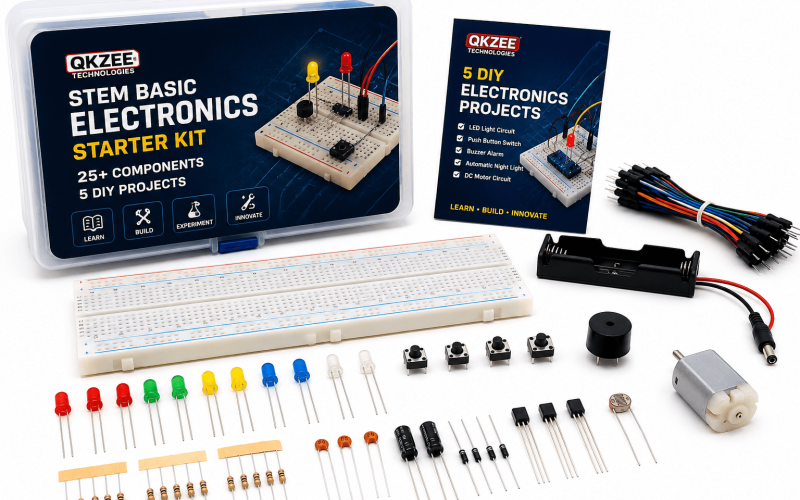
The QKZEE STEM Basic Electronics Starter Kit is specially designed for kids, school students, beginners, parents, teachers, and STEM enthusiasts who want to learn electronics through practical experiments. This complete beginner-friendly STEM kit contains 25+ high-quality electronic components, including LEDs, resistors, capacitors, diodes, transistors, push buttons, breadboard, jumper wires, battery holder, buzzer, DC motor, and LDR sensor.
With this kit, students can build 5 exciting DIY electronics projects while learning the fundamentals of electricity, current flow, voltage, resistance, electronic components, and circuit design—without soldering.
Perfect for STEM education, science exhibitions, robotics clubs, engineering students, home learning, school laboratories, and science fair competitions across Pakistan
This guide from Qkzee walks you through the entire water level indicator project in plain, simple language — no confusing jargon, just clear steps a student can follow and explain confidently to teachers and judges.
Designed specifically for:
Breadboard
A solderless breadboard allows students to assemble circuits without soldering. Components can be inserted and removed repeatedly, making experimentation easy and safe.
Jumper Wires
Flexible jumper wires connect components on the breadboard and help learners understand circuit connections.
LEDs
Five different LED colours allow students to build lighting circuits while learning polarity, current flow, and resistor selection.
Resistors
Multiple resistor values are included to demonstrate current limiting and voltage distribution in electronic circuits.
Capacitors
Students learn about temporary energy storage, filtering, and simple timing concepts using ceramic and electrolytic capacitors.
Diodes
Diodes introduce one-way current flow and protection against reverse polarity.
Transistors
BC547 transistors are commonly used in educational electronics and allow students to explore switching and amplification concepts.
Push Buttons
Push buttons act as simple user input devices and are used in many beginner circuits.
Mini DC Motor
The motor demonstrates the conversion of electrical energy into mechanical motion and introduces basic motor control concepts.
Piezo Buzzer
The buzzer provides audible feedback and helps learners build simple alarm and indicator circuits.
Light Dependent Resistor (LDR)
The LDR changes resistance based on light intensity and introduces the concept of automatic light-controlled circuits.
Package Contents
Each package includes:
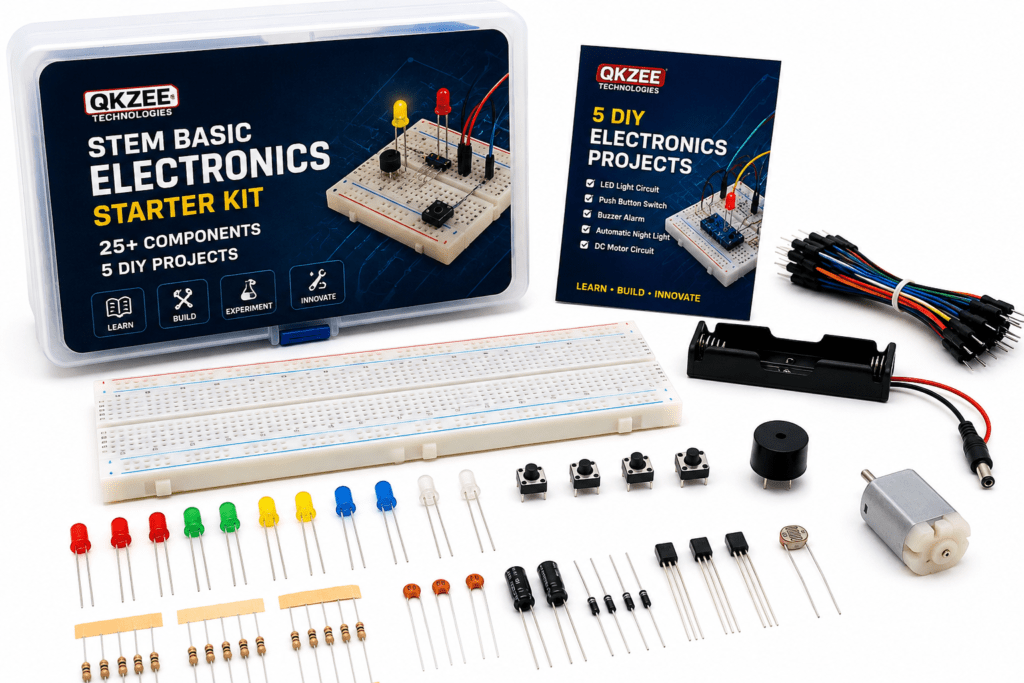
The QKZEE STEM Basic Electronics Starter Kit includes components that allow beginners to build five practical electronics projects. Each project introduces a new concept while helping learners gain confidence in assembling real electronic circuits.
These projects are designed to be simple enough for beginners while providing a strong foundation for more advanced electronics, robotics, and Arduino projects.
Project 1 – LED Light Circuit
Project Objective
Learn how to build your very first electronic circuit by lighting an LED using a resistor and battery.
Components Required
STEM Concepts Learned
How It Works
The battery supplies electrical energy to the circuit. The resistor limits the current flowing through the LED, protecting it from damage. When connected correctly, the LED lights up, demonstrating a complete electrical circuit.
Learning Outcomes
Students will learn:
Difficulty Level
⭐ Beginner
Real-Life Applications
Project 2 – Push Button LED Switch
Project Objective
Understand how switches control the flow of electricity.
Components Required
STEM Concepts Learned
How It Works
When the push button is pressed, the circuit closes, allowing current to flow through the LED. Releasing the button opens the circuit and turns the LED off.
Learning Outcomes
Students understand:
Difficulty Level
⭐ Beginner
Real-Life Applications
Project 3 – Electronic Buzzer Alarm
Project Objective
Learn how electrical energy is converted into sound using a piezo buzzer.
Components Required
STEM Concepts Learned
How It Works
When the push button is pressed, electrical current reaches the piezo buzzer, producing an audible sound. This demonstrates how electronic devices provide sound-based notifications.
Learning Outcomes
Students will learn:
Difficulty Level
⭐ Beginner
Real-Life Applications
Project 4 – Automatic Night Light (LDR Project)
Project Objective
Learn how sensors detect environmental changes and automatically control electronic devices.
Components Required
STEM Concepts Learned
How It Works
The LDR changes its electrical resistance based on the surrounding light level. As the environment becomes darker, the circuit responds by allowing the LED to illuminate automatically.
Learning Outcomes
Students will understand:
Difficulty Level
⭐⭐ Beginner to Intermediate
Real-Life Applications
Project 5 – Mini Motor Circuit
Project Objective
Understand how electricity can produce mechanical movement using a DC motor.
Components Required
STEM Concepts Learned
How It Works
When electrical current reaches the motor, it begins rotating. This demonstrates how electrical energy is converted into mechanical motion, a principle used in countless everyday devices.
Learning Outcomes
Students learn:
Difficulty Level
⭐⭐ Beginner to Intermediate
Real-Life Applications
These practical activities help students:
These projects are suitable for:
Each project is designed to introduce one or more core electronics concepts through practical experimentation. By progressing from a simple LED circuit to sensor-based automation and motor control, learners build knowledge step by step. This structured approach helps develop confidence while preparing students for more advanced STEM and engineering projects
This simple transistor water level indicator isn’t just for school — the same concept is used in:
Mentioning these applications in your school project file is a great way to show practical understanding, not just circuit building.
Looking for affordable components for this Arduino project? Check out QKZee Technologies, an online shop in Lahore, Pakistan, offering the best components for students and DIY projects. Whether you’re looking for sensors, modules, or other electronics at a cheap price, they’ve got it all. Visit them at QKZeeTech.
Inspire the next generation of innovators with the QKZEE STEM Basic Electronics Starter Kit.
Whether you’re a parent encouraging hands-on learning, a teacher building engaging STEM lessons, or a student beginning your electronics journey, this kit offers a practical and enjoyable introduction to electronics. Build real circuits, develop valuable technical skills, and lay the foundation for future projects in robotics, Arduino, IoT, and engineering.
Order today and start learning through creativity, experimentation, and innovation with QKZEE Technologies.
It is a beginner-friendly educational electronics kit designed to teach the basics of electrical and electronic circuits through hands-on STEM learning and DIY projects.
This kit is suitable for:
Yes. No previous electronics knowledge is required. The kit is designed specifically for beginners.
No. All projects are built using a reusable solderless breadboard.
The kit supports 5 guided DIY projects, and the reusable components allow learners to create many additional circuits by experimenting with different combinations.
Yes. The components and breadboard are reusable with proper care.
Yes. It is ideal for science laboratories, STEM classrooms, engineering workshops, and robotics clubs
You will learn: